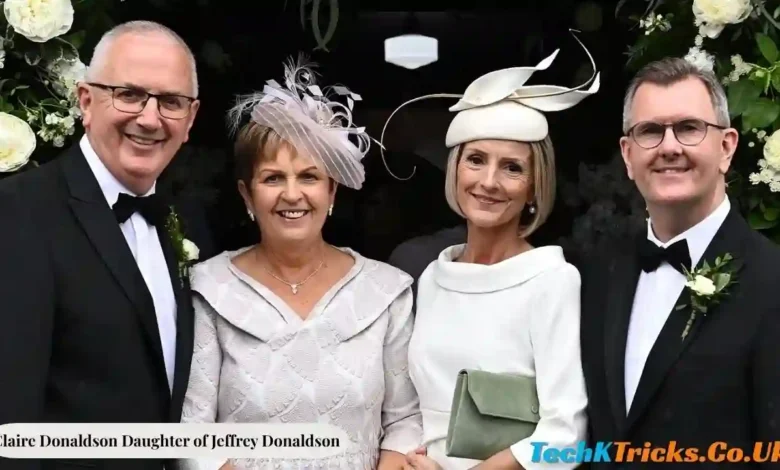
Claire Donaldson Daughter of Jeffrey Donaldson Who Forged Her Own Identity
Introduction
Some stories don’t begin with a grand entrance into the spotlight. Some begin quietly — in a household shaped by faith, politics, and public duty — and unfold through deliberate, personal choices made far from the cameras. That’s exactly the kind of story Claire Donaldson carries.
Claire Donaldson daughter of Jeffrey Donaldson, one of Northern Ireland’s most prominent and long-serving political figures, has built a life that is entirely her own. While her father occupies the corridors of Westminster and the front pages of political news, Claire has chosen the corridors of healthcare — working as a diagnostic radiographer, a skilled medical professional whose work directly impacts lives every single day.
What makes her story compelling isn’t conflict or drama. It’s identity. It’s the quiet but meaningful journey of a woman who grew up in one of Northern Ireland’s most recognisable political households and emerged with her own convictions, her own career, and her own voice. Claire Donaldson represents something many people find deeply relatable — the experience of being shaped by your upbringing while ultimately becoming something beyond it.
Who Is Jeffrey Donaldson?
To understand Claire Donaldson’s story, it helps to first understand the world she grew up in.
Sir Jeffrey Mark Donaldson was born in Kilkeel, County Down, in 1962. He entered politics at a remarkably young age and went on to become one of the most influential and recognisable figures in the Democratic Unionist Party. Over decades in public life, he became a central voice in some of the most consequential political debates in Northern Ireland’s modern history — from the peace process and Brexit negotiations to the ongoing complexities of the Northern Ireland Protocol.
Jeffrey Donaldson has long been associated with conservative and unionist values. His political positions have been shaped by his deep Christian faith, and he has consistently championed pro-life causes throughout his career. He is a politician who holds firm to his principles — something that has earned him both fierce loyalty and strong opposition depending on who you ask.
Despite being a major public figure, Jeffrey Donaldson has maintained a notably private family life. He is married and has two daughters, and he has generally kept those relationships away from the public gaze. That discretion speaks volumes about the kind of home environment his family has inhabited — one where public duty and private life are kept deliberately separate.
Claire Donaldson — Early Life and Family
Claire Donaldson grew up as part of a family that was, by any measure, deeply embedded in public life — even if the family home itself remained a sanctuary from it.
Jeffrey Donaldson married Lady Eleanor Donaldson in 1994, and their partnership has been described as one of the cornerstones of his political career. Eleanor has been referred to as his “rock” — a steadying, supportive presence who has provided consistency and stability through decades of demanding political work. She has stood beside her husband at key moments, including his knighthood ceremony in 2016, while largely maintaining her own private life away from parliamentary coverage.
For Claire, growing up in such a household would have meant navigating a unique blend of experiences. Children raised in politically prominent families often develop a remarkable kind of adaptability — learning to manage unpredictable schedules, public events, travel, and the ever-present awareness that their family name carries weight. At the same time, those households tend to instil a strong sense of civic responsibility, ethical awareness, and the understanding that public service matters.
The values present in the Donaldson home — faith, commitment to community, and a sense of duty — likely shaped Claire in foundational ways. But as with many children of public figures, those foundations became a launchpad rather than a ceiling.
Claire’s Professional Life
One of the most telling things about Claire Donaldson is what she chose to do with her life. Rather than following her father into politics or public commentary, she went into healthcare.
Claire works as a diagnostic radiographer — a medical imaging specialist responsible for performing X-rays, scans, and other imaging procedures to help diagnose illness and injury. It’s a profession that requires years of rigorous training, a high level of technical precision, and a steady, compassionate presence with patients who are often anxious or unwell.
This career choice says a great deal about who Claire Donaldson is. Diagnostic radiography is not a glamorous profession in the public sense — it’s demanding, detail-oriented, and deeply service-focused. It is a role that places her at the intersection of science, technology, and human care. Every day, the work she does has a direct and tangible impact on real people.
Her choice to work in healthcare also means that policy debates around the NHS, medical funding, and healthcare rights are not abstract to her. They are lived realities. That professional grounding shapes how she sees the world — and it likely informs her perspective on the social and political issues she has chosen to speak out about.
Claire’s Public Advocacy — Reproductive Rights
It was her advocacy work, rather than her profession, that first brought Claire Donaldson to wider public attention.
Claire has been associated with pro-choice advocacy and has reportedly participated in public demonstrations and campaigns calling for expanded access to abortion services and reproductive healthcare. Her name became part of the public conversation around 2018, when reports linked her to support for abortion law reform in Northern Ireland — a position that immediately stood out because of who her father is.
Northern Ireland, at the time, had some of the most restrictive abortion laws in the United Kingdom. The debate around reform was intense, politically charged, and deeply personal for many. For Claire Donaldson daughter of Jeffrey Donaldson, a politician firmly opposed to abortion rights, to publicly align herself with the pro-choice movement was not a small thing. It was a statement.
Her advocacy didn’t appear to be made for headlines. There’s no record of her seeking interviews or media coverage around these activities. It seemed, from all available accounts, like genuine participation — the kind that comes from personal conviction rather than a desire for visibility.
The Ideological Divide — Father vs. Daughter
The contrast between Jeffrey Donaldson’s political position on reproductive rights and his daughter Claire’s public advocacy is perhaps the most discussed aspect of her story — but it deserves to be understood carefully, not sensationalised.
Jeffrey Donaldson has consistently opposed abortion rights throughout his career, in keeping with the DUP’s long-standing pro-life stance. His position is rooted in deeply held religious and moral convictions, and it has been a consistent thread through his decades in public life.
Claire Donaldson, by contrast, has associated herself with the argument for women’s reproductive freedom — a position rooted in a different but equally sincere moral framework, one that centres patient autonomy, healthcare access, and the lived experiences of women navigating difficult circumstances.
These are genuinely opposing positions on one of the most sensitive and divisive ethical debates in politics. And yet, by all available accounts, there has been no public falling-out between them. No heated exchanges on social media. No estrangement reported in the press. What seems to exist instead is something rarer and more instructive — a respectful coexistence of differing beliefs within a family bound by love.
That dynamic, while deeply personal, reflects something broader. Families across Northern Ireland — across the whole of the United Kingdom and Ireland — contain people who hold very different views on abortion, yet continue to sit across from each other at the dinner table. The Donaldsons, it seems, are no different in that regard.
What Claire’s advocacy ultimately represents, in contrast to her father’s legacy, is a different kind of moral leadership — one grounded in healthcare experience, in the direct observation of how policy affects patients, and in a generation that has grown up in a changing society.
Privacy and Life in the Public Eye
For someone whose name draws a significant amount of search interest, Claire Donaldson has maintained a remarkably low public profile.
She has appeared publicly in sanctioned, family contexts — most notably at her father’s knighthood ceremony in 2016 — but beyond moments like that, she has largely stayed away from media attention. Her limited presence in news coverage and on social media suggests that she genuinely values her privacy and has made a conscious decision not to become a public figure.
That choice is worth respecting. Journalists and the public can sometimes treat politicians’ family members as extensions of the politician themselves — as if the personal lives of a public figure’s children are fair game simply by association. But Claire Donaldson has her own career, her own values, and her own life. Her connection to her father is part of her story, but it is not the whole of it.
She has chosen to engage publicly only when she feels strongly enough about a cause to do so — and that selective, intentional approach to public engagement is itself a kind of statement about how she wants to move through the world.
Claire as a Symbol of Generational Shift
Claire Donaldson’s story is, in many ways, a microcosm of something happening much more broadly across Northern Ireland and beyond.
Her generation has grown up in a Northern Ireland that is politically and socially different from the one her father entered as a young politician. The peace process transformed the landscape. Changing demographics, evolving attitudes toward religion and social policy, and increased connectivity with the wider world have all shifted the terrain. Many younger Northern Irish people — particularly those working in fields like healthcare, education, and social services — have moved away from the more conservative social positions of their parents’ generation, while often retaining a strong sense of community identity and civic values.
Claire reflects that shift. Her perspective appears to be shaped not primarily by party politics or ideological tradition, but by real-world experience — the experience of working in a healthcare system, of understanding what access to medical care actually means in practice, and of living through a period of significant social change.
Healthcare professionals in particular often develop nuanced, experience-driven views on social policy. When you work with patients, you encounter the full range of human circumstances. You see what happens when systems fail, when care is denied, and when people navigate impossible decisions without adequate support. That kind of work changes how you think about policy — and likely has for Claire.
Conclusion
The story of Claire Donaldson daughter of Jeffrey Donaldson, is not, at its heart, a story about political division or family conflict. It’s a story about identity, about the way individuals find their own path even when the road their family has travelled is a well-worn one.
Claire has built a meaningful career in healthcare, shown genuine civic engagement through her advocacy work, and maintained her privacy with quiet dignity. She hasn’t sought the spotlight, and she hasn’t defined herself in opposition to her father. She has simply lived her own life — and in doing so, she has become an interesting, admirable figure in her own right.
What the Donaldson family ultimately represents — perhaps without intending to — is something that many families share: the ability to hold different beliefs, to respect each other’s humanity, and to exist together across lines of disagreement. In a political climate that often rewards division over nuance, that’s a quietly powerful thing.
Two perspectives. One family. And at the centre of it, a woman — Claire Donaldson — who made her own choices and continues to live by them.
Also Read: Zeinab Badawi Husband, Personal Life & Remarkable Journey as President of SOAS, University of London