Axial Tilt North America Towards Sun Rays: How Earth’s Tilt Creates Seasons
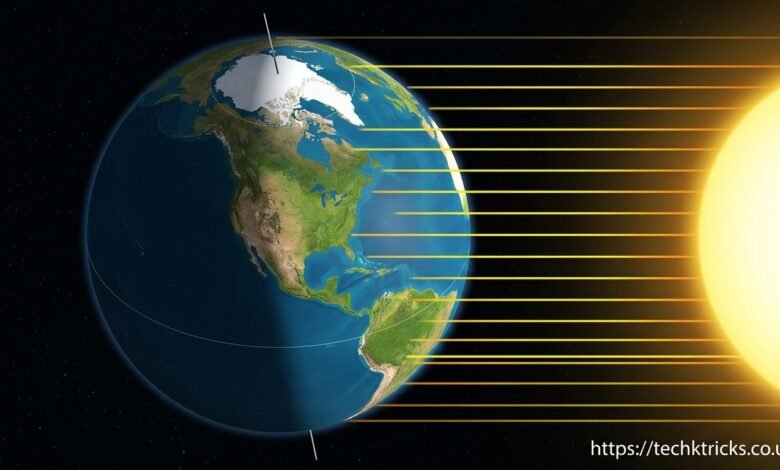
The phrase “axial tilt North America towards sun rays” describes an important astronomical relationship between Earth’s tilted rotational axis, North America’s position in the Northern Hemisphere, and the changing angle of sunlight throughout the year. Earth does not orbit the Sun with its axis perfectly upright. Instead, its rotational axis is tilted by about 23.5 degrees relative to the plane of its orbit. As Earth travels around the Sun, this tilt causes the Northern Hemisphere to receive changing amounts and angles of solar energy.
For people living across North America, this relationship is especially noticeable because the continent experiences major changes in daylight length, solar elevation, temperatures, and seasonal weather. When the Northern Hemisphere is tilted toward the Sun around the June solstice, sunlight reaches North America at a more direct angle and daylight lasts longer. Around the December solstice, the Northern Hemisphere is tilted away from the Sun, producing lower solar angles, shorter days, and generally colder conditions.
Understanding Earth’s Axial Tilt
Earth’s axial tilt, also called obliquity, is the angle between Earth’s rotational axis and a line perpendicular to its orbital plane. The commonly used value is approximately 23.5 degrees, although more precise modern measurements often describe the present value as about 23.4 degrees. This tilt is one of the fundamental reasons Earth has seasons.
Earth completes one orbit around the Sun in approximately one year while rotating once roughly every 24 hours. As it moves along its orbit, the direction of the tilted axis remains approximately fixed in space. Consequently, different hemispheres receive different solar angles during different portions of the year. When the Northern Hemisphere is tilted toward the Sun, locations throughout North America generally receive more concentrated solar energy and longer periods of daylight.
What Happens When North America Tilts Toward the Sun?
North America is not physically tipping independently toward the Sun. Rather, much of the continent is located in the Northern Hemisphere, which becomes oriented toward the Sun during the northern summer. Around the June solstice, the North Pole is tilted toward the Sun, and the Sun’s most direct rays reach the Tropic of Cancer at approximately 23.5 degrees north latitude.
This positioning changes the way sunlight reaches North America. The Sun appears higher in the sky during the day across much of the continent, and the incoming rays strike the surface more directly. The same amount of solar radiation is therefore distributed over a smaller surface area compared with a lower-angle Sun. Longer daylight also allows the surface to receive solar energy for more hours.
Why Sun Rays Become More Direct in Summer
The angle of incoming sunlight is critical to understanding seasonal temperature changes. When sunlight approaches the ground at a high angle, its energy is concentrated over a relatively smaller area. When sunlight arrives at a lower angle, the same energy is spread over a larger area.
During northern summer, North America’s orientation toward the Sun produces higher solar elevations and longer daylight hours. NOAA explains that Earth’s 23.5-degree tilt changes the distribution of the Sun’s energy across the surface, with the Northern Hemisphere receiving the most direct radiation around the June solstice.
This is why summer sunlight can provide substantially more daily solar energy than winter sunlight in many parts of North America. The effect becomes particularly noticeable at higher latitudes, where the difference between summer and winter daylight can be dramatic.
North America During the June Solstice
The June solstice marks the point in Earth’s orbit when the Northern Hemisphere is tilted most strongly toward the Sun. It normally occurs around June 20 or 21. For North America and other Northern Hemisphere locations, it marks the astronomical beginning of summer.
At this time, the Sun’s direct rays are positioned over the Tropic of Cancer. Locations north of the equator generally experience longer days than nights, with the difference becoming increasingly large toward the Arctic. Near and above the Arctic Circle, some locations experience continuous daylight around the summer solstice.
This explains why northern parts of North America, including Alaska and northern Canada, can experience extremely long summer days. At the North Pole itself, daylight can continue for months rather than following the ordinary daily sunrise-and-sunset pattern.
What Happens During the December Solstice?
The situation reverses around the December solstice. The Northern Hemisphere is then tilted away from the Sun, while the Southern Hemisphere is tilted toward it. As a result, North America receives sunlight at lower angles and experiences shorter daylight periods.
In many parts of North America, the Sun follows a lower path across the southern sky during winter. NOAA notes that in North America during winter, the Sun’s apparent path is farther toward the south, with sunrise and sunset occurring generally toward the southeast and southwest respectively.
Lower solar elevation means sunlight is less concentrated on the surface. Shorter days also reduce the number of hours during which the ground can absorb solar energy. Together, these factors contribute to winter’s colder conditions, although atmospheric circulation, oceans, snow cover, elevation, and other geographic factors also strongly affect local climates.
Axial Tilt and Daylight Length
One of the clearest effects of Earth’s axial tilt is the changing length of daylight. During the Northern Hemisphere’s summer, North American locations receive more daylight because the northern half of Earth is oriented toward the Sun. During winter, the same locations experience shorter days.
The difference is relatively modest near the equator but becomes much greater at higher latitudes. For example, Alaska can experience exceptionally long summer days and exceptionally short winter days. This is because the geometry of Earth’s tilted axis produces increasingly large changes in the visible path of the Sun as one moves farther from the equator.
Therefore, axial tilt affects not only how directly sunlight reaches North America but also how long that sunlight remains available each day.
Equinoxes: When North America Gets a More Balanced Sun Angle
Between the solstices are the March and September equinoxes. During an equinox, Earth’s axis is not tilted toward or away from the Sun in the same way it is during a solstice. The Sun is positioned over the equator, and day and night are approximately equal in length around much of the world.
For North America, the equinoxes represent transitional periods between the stronger seasonal solar geometries of summer and winter. After the March equinox, the Northern Hemisphere continues moving toward its summer orientation. After the September equinox, it moves toward its winter orientation.
The equinoxes therefore help explain why the Sun’s apparent path gradually shifts northward and southward across the sky throughout the year.
Does Earth’s Distance From the Sun Cause North American Seasons?
A common misconception is that summer occurs because Earth is closer to the Sun. This is not the primary cause of the seasons. Earth’s orbit is slightly elliptical, meaning its distance from the Sun changes during the year. However, the Northern Hemisphere experiences winter around January, when Earth is actually closer to the Sun, and summer around July, when Earth is farther away.
The much more important factor is axial tilt. When North America and the rest of the Northern Hemisphere are tilted toward the Sun, the sunlight arrives more directly and days are longer. When the hemisphere is tilted away, sunlight arrives at a lower angle and days become shorter.
This distinction is essential when explaining the keyword “axial tilt North America towards sun rays.” The key relationship is not simply distance but orientation, solar angle, and daylight duration.
How Latitude Changes Sunlight Across North America
North America extends across a very large range of latitudes, from tropical regions near the Caribbean and southern Mexico to Arctic regions in Canada and Alaska. Because solar geometry varies with latitude, the effect of axial tilt is not identical everywhere.
Southern parts of North America generally experience smaller seasonal changes in daylight compared with far northern regions. In contrast, locations at high northern latitudes can experience extreme differences between summer and winter daylight.
The angle of the Sun also changes with latitude. Near the Tropic of Cancer, the Sun can be nearly overhead around the June solstice. Farther north, even during summer, the Sun remains lower in the sky. This is one reason latitude is an important factor when studying the distribution of solar energy across the continent.
Axial Tilt and North American Climate
Axial tilt provides the astronomical foundation for seasonal changes, but it does not determine every aspect of North American weather. Oceans, mountains, atmospheric circulation, land cover, elevation, and regional geography all influence climate.
For example, two places at similar latitudes can have noticeably different climates because one may be influenced by a nearby ocean while another is located deep within a continental interior. Snow and ice can also reflect a significant portion of incoming sunlight, while forests, cities, deserts, and water surfaces absorb and redistribute energy differently.
There is also a delay between the peak of incoming solar energy and the warmest average temperatures. NOAA describes this as seasonal lag: temperatures in much of the United States can continue rising after the June solstice because the surface and atmosphere continue gaining more heat than they lose for a period of time.
Why the Axial Tilt Matters Beyond the Seasons
Earth’s axial tilt is not merely a simple seasonal mechanism. Over extremely long geological timescales, the tilt itself changes gradually. NASA reports that Earth’s obliquity has varied over approximately 22.1 to 24.5 degrees during long-term cycles, with the current tilt around 23.4 degrees. These changes occur over tens of thousands of years and influence the distribution of solar radiation, particularly at higher latitudes.
A larger tilt can produce more pronounced seasonal contrasts, while a smaller tilt tends to reduce seasonal differences. These long-term orbital variations are part of what scientists call Milankovitch cycles, which are important in understanding Earth’s long-term climate history.
For everyday life in North America, however, the present axial tilt is essentially stable on human timescales. The seasonal changes people observe from one year to the next are primarily the result of Earth’s regular orbit around the Sun combined with its existing axial tilt.
Final Thoughts on Axial Tilt North America Towards Sun Rays
The concept of axial tilt North America towards sun rays can be summarized through a simple chain of events: Earth has an axial tilt of roughly 23.5 degrees, Earth orbits the Sun, and the Northern Hemisphere alternately tilts toward and away from the Sun during the year. When it is tilted toward the Sun, North America generally receives higher-angle sunlight and longer daylight, producing the astronomical conditions associated with summer. When it is tilted away, sunlight arrives at lower angles and daylight becomes shorter, producing winter conditions.
The June and December solstices represent the strongest seasonal differences, while the March and September equinoxes provide transitional points when the hemispheres receive more balanced sunlight. Understanding this geometry makes it easier to explain seasonal sunlight, changing day length, solar elevation, and many of the climate patterns experienced across North America.